

How to make one quarterly letter fit clients at different levels of sophistication
You have clients with different levels of financial sophistication. But you probably don’t have the time to write separate letters tailored to each client’s understanding of investment jargon. To help you manage your time–and keep your clients happy–here are my top five tips for a one-size-fits-all client letter.
I’d like to thank the Maine CFA Society for suggesting this blog post topic when I presented to them on “How to Write Investment Commentary People Will Read.”
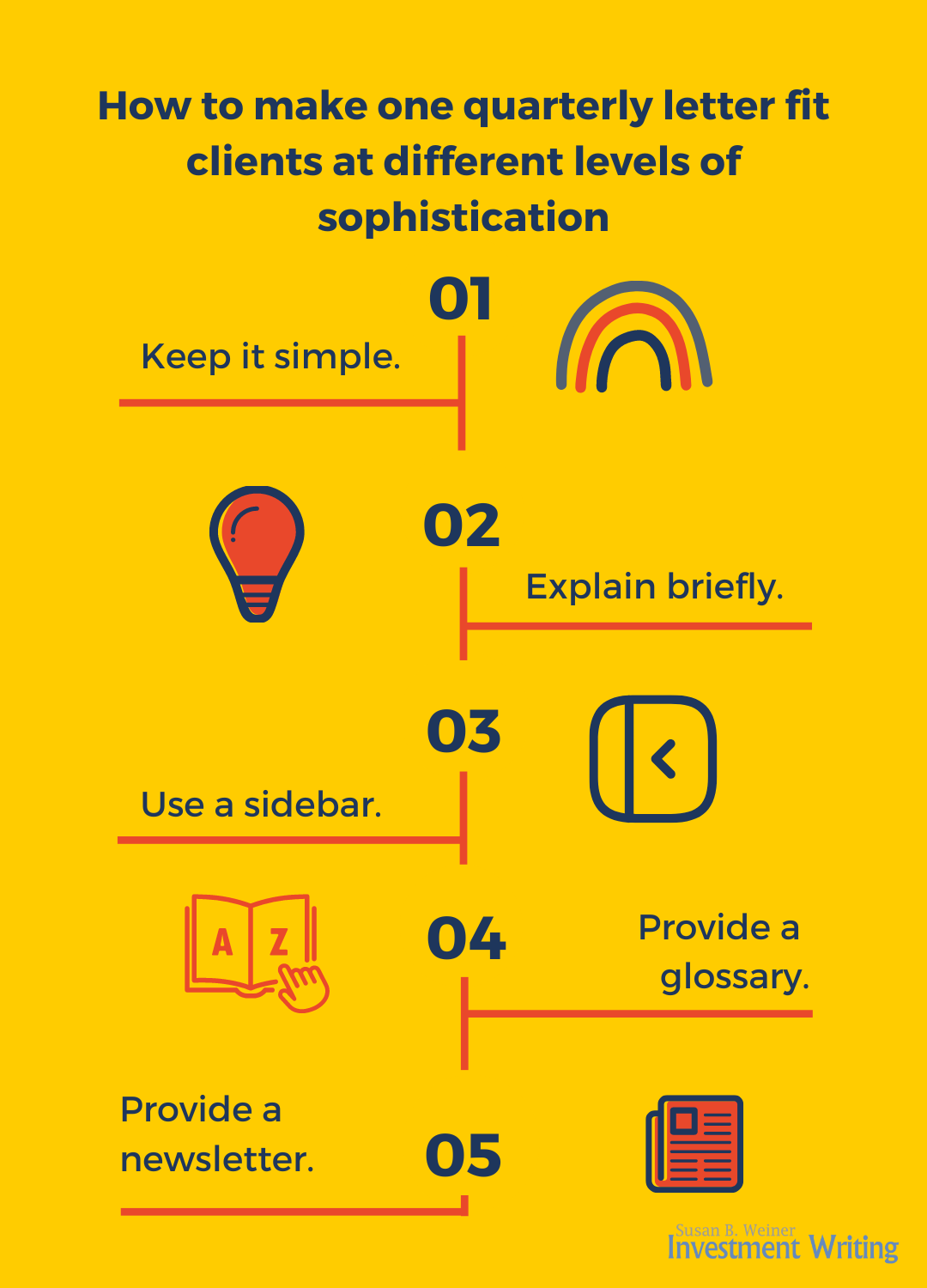
1. Keep it simple
If you use plain language, all of your readers will understand you.
Follow the example of Berkshire Hathaway’s Warren Buffett, who says, “When writing Berkshire Hathaway’s annual report, I pretend that I’m talking to my sisters…. They will understand plain English, but jargon may puzzle them.” Despite Buffett’s easy-to-understand style, plenty of financial sophisticates read his firm’s annual report.
2. Explain briefly
The Wall Street Journal has mastered the art of explaining technical terms with phrases set off by commas. For example, a reporter might write about “the carry trade, where investors borrow in currencies with low interest rates to invest in those with high interest rates.”
Savvy investors skim over the explanations, while the less knowledgeable gain a quick understanding.
3. Use a sidebar
A sidebar, which is a text box that’s set off from the main body of your article, can help you to accommodate different levels of knowledge among your readers.
Let’s consider my example in Tip #2. You could use a sidebar to explain the carry trade in more depth. Your goal could be to educate less sophisticated investors. Or, you may convey details to more educated investors that wouldn’t interest the rest of your readers.
4. Provide a glossary
A glossary at the end of your printed communication can help when you can’t squeeze all of the necessary explanations into the body of your text.
If you send electronic communications, you can provide click-through links to definitions on your website or elsewhere.
If you’re willing to link to third-party glossaries, you’ve got a variety of choices. I’ve found some good definitions on the following sites:
5. Provide a newsletter with articles for different audiences
If you have the luxury of writing a multi-article newsletter for your clients, consider including articles aimed at different levels of sophistication.
However, don’t vary your level willy-nilly. I’d suggest aiming your newsletter at a general audience and then consistently including one article targeting better educated readers.
How do YOU handle this challenge?
I’m interested in hearing from you. Please leave comments below.
Image courtesy of stupakidmod at FreeDigitalPhotos.net.

Trackbacks & Pingbacks
[…] Sometimes it’s useful to give a brief explanation of technical terms, as I described in “How to make one quarterly letter fit clients at different levels of sophistication.” […]
Comments are closed.